
“The structure of thought is changing, as is its very nature. Patterns of thought are becoming less rational. With the collapse of many of the hierarchies of the Modern Era, systems of knowledge have been replaced by multifaceted alternatives. People are moving away from the hierarchical structures of rational thought toward perceptual, seemingly less structured forms of thinking, and toward a more irrational mode of thought. This apparent irrationality may, in fact, be the most appropriate way of approaching a world that has moved beyond the modern utopian faith in rational solutions.”
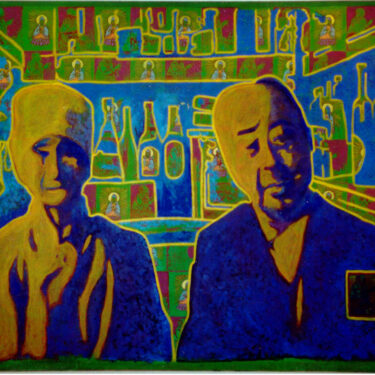
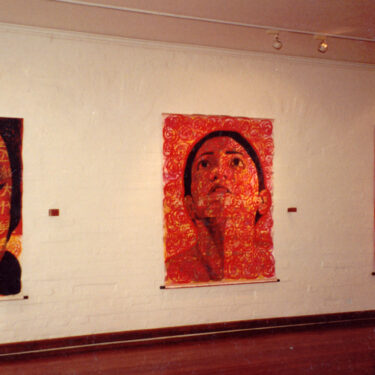
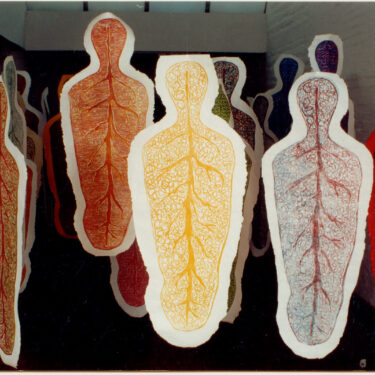
Taking Jeffrey Deitch’s proposition as a point of departure, this series of works leaves room for intuition and perception as ways of approaching images and events that, because of cultural differences, resist rational interpretation.
How can one understand and make sense of a society such as China at that time, immersed in the rapid construction of a consumer culture while simultaneously shaped by a millennia-old cultural heritage and the recent political legacy of the Cultural Revolution?
Faced with this complexity, my work seeks neither to propose alternatives nor to formulate aesthetic or metaphysical solutions. Instead, I position myself as a witness to the events that confront me daily, using artistic practice to explore what lies beneath the surface of everyday reality.
The overwhelming crowds; billboards juxtaposing millennia-old iconography with advertisements for new websites; the omnipresence of mobile phones; the explosive growth of buildings and avenues; and the daily demolition of old structures form a landscape in perpetual transformation. Everything suggests that this is not a time for answers or certainties, but for continuous deconstruction and reconstruction.
It is within this context that I recognize myself: I DEMOLISHED / I RECONSTRUCTED. The incessant pounding of construction work, the abrupt transformation of the urban landscape, the demolitions and, above all, the ceaseless presence of people become metaphors for my own experience. Meanwhile, news reaching me through the internet from distant places reveals parallel processes: societies struggling to shed obsolete structures, adapt to new realities, and rebuild themselves.
To explore this ongoing process of self-demolition and reconstruction, I turn to irony and parody. Images from the past are intuitively juxtaposed with objects, signs, and elements of contemporary life. I incorporate both unfamiliar faces and my own, as the face and the body have become focal points of contemporary society and of our relationship with the gaze of others.
My own face takes on an ambiguous quality: it does not necessarily disclose my origins and can be associated with different nationalities. This apparent indeterminacy allows me to consider identity as a shifting territory, capable of blending in, transforming, and adapting to its surroundings.
Just as my body adapts to the cultural landscape around me, my images seek to blend into a society undergoing profound transformation. I Demolished / I Reconstructed thus speaks of an identity shaped by constant movement: of what must come apart to be rebuilt, of the experience of inhabiting a world in perpetual change, and of the need to reconstruct oneself with every new context.
Diana Valarezo, 2000
Originally published in Diners magazine, pp. 32–37.