Imagined Consciousness: Cartographies of the New World and Its Monsters
By Sonia Kraemer, Ph.D.
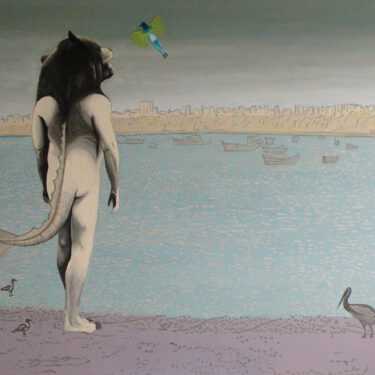
The exhibition Imagined Consciousness is a project that began in 2010, when Diana Valarezo (Guayaquil, 1968) left Ecuador and, within a short period of time, lived in three very different countries: Senegal, Belgium, and Peru. As an indefatigable traveller, one of the recurring leitmotifs in her work is the representation of otherness and the questioning of her own identity. The traveller is “the other”, the foreigner, the “monster”. It is worth remembering that, in some languages, the word for foreigner is the same as that for extraterrestrial. When travelling for extended periods, even upon returning home, one becomes a stranger in one’s own land.
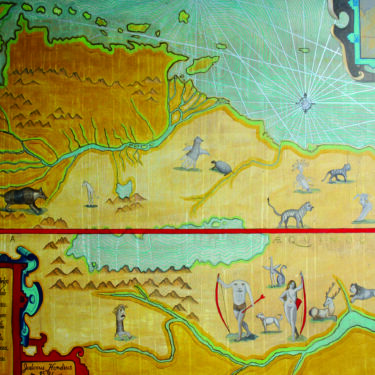
The idea of the other as a monster emerges from readings of Christopher Columbus’s chronicles of the Indies, the writings of Bartolomé de las Casas, with their fascinating descriptions of mythical beings, and the work of cartographers from the Low Countries. One of their foremost representatives was the Belgian cartographer Jodocus Hondius, who, in 1596, produced one of the earliest atlases of South America, depicting extraordinary creatures, chimeras, and other aberrations. The foreigner’s gaze is one of fascination; imagination interprets everything it encounters, and these accounts gave rise to an imaginary vision of America. Such myths would remain deeply embedded for centuries in the European collective memory of the West Indies.
Miguel Rojas-Mix (Santiago de Chile, 1934), a leading scholar on the subject and author of América Imaginaria (Lumen, 1992), recently republished, discusses the relationship between otherness and the monster in an interview:
“Monsters are somewhat like golems created by cultures out of their fears, xenophobia, anathemas, or the unknown, among other factors. They are a reflection of the worst aspects of those cultures themselves: their prejudices and contempt, their most deeply rooted and primal fears. America was the New World: an immense expanse of land waiting to be discovered. It was therefore populated by monsters long before it was explored.”[i]
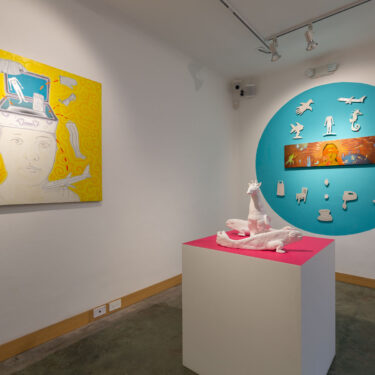
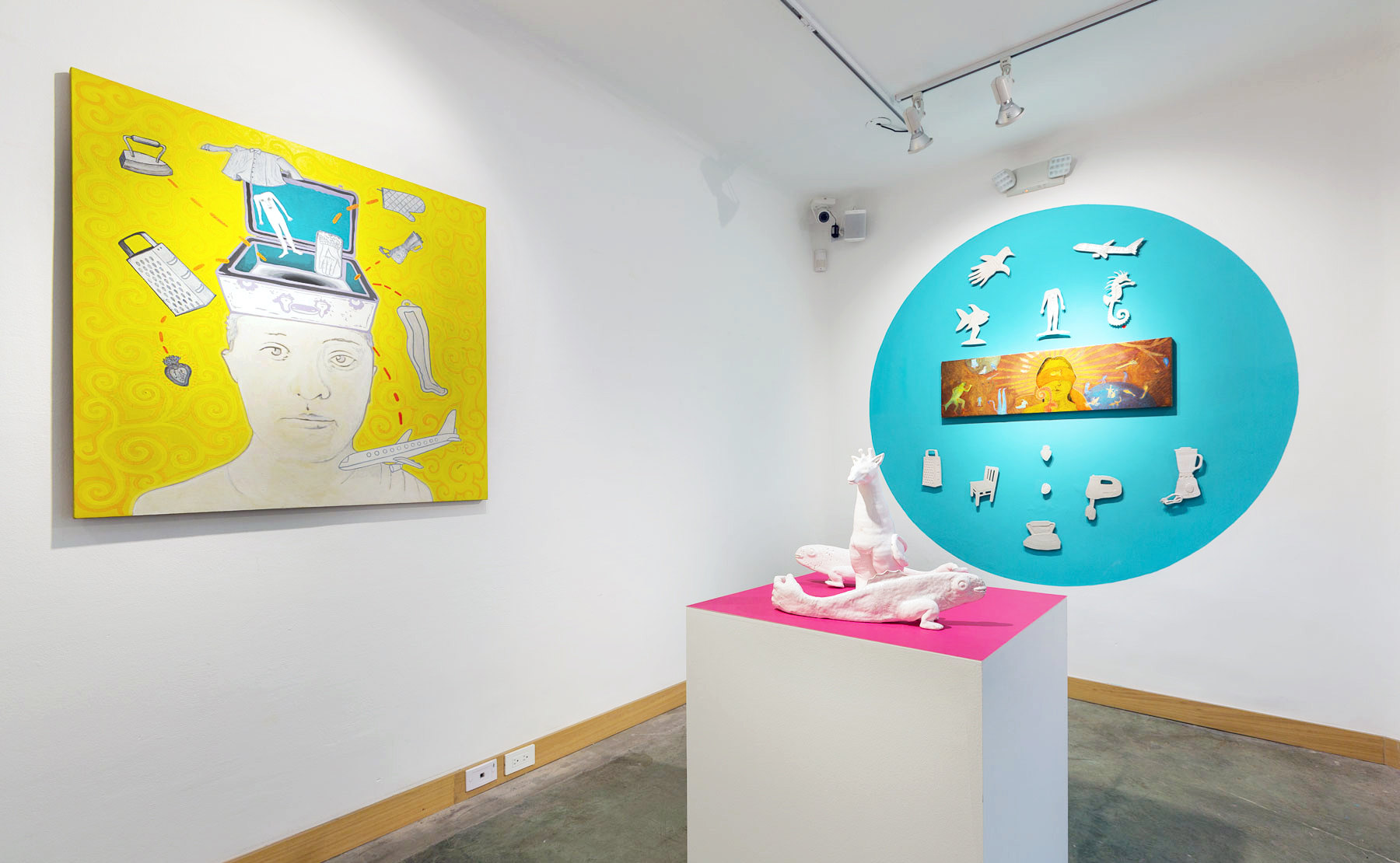
Diana Valarezo investigates and delves into these sources, drawing inspiration as well from medieval imagery, ancient cartographies, the illustrations of Guamán Poma de Ayala, and the art of Hieronymus Bosch to create this series of works depicting travel and the objects associated with it. Among these is the suitcase, which contains what Virginia Woolf might have called one’s “room of one’s own”, albeit a portable one.
These elements—our clothes and personal belongings that we carry when travelling—represent the familiar, a source of security in the face of the vastness of the unfamiliar and the fear of the unknown. By reflecting on and revisiting these chronicles, the artist places herself in the position of the “conquistadors”, seeking to understand their fears and anxieties. These men, who came from some of the poorest regions of Extremadura, were driven by a thirst for power and glory. Yet they were also human beings, terrified by the unknown, gazing towards the “beyond” in a world that, until relatively recently, had been considered flat. They were in search of paradise, the chimera of a dream in the New World, where they imagined they would become lords, nobles, and landowners.
The unknown is constructed through imagination; myth emerges from the terror that inhabits unexplored territories. From the sense of estrangement within the foreigner’s gaze arise mythical creatures such as the harpy, the gastrocéphale (a creature with its head in its abdomen), and the mermaids.
Diana identifies with the monster. As a foreigner, she has always been perceived as something exotic, different, and, at times, has even felt invisible, like a ghost. This is the migrant’s dilemma: a fractured identity. When we travel and live in other territories, our perception of what is familiar changes. Upon returning to our own surroundings, we see them anew, experiencing a sense of estrangement towards what once seemed self-evident.
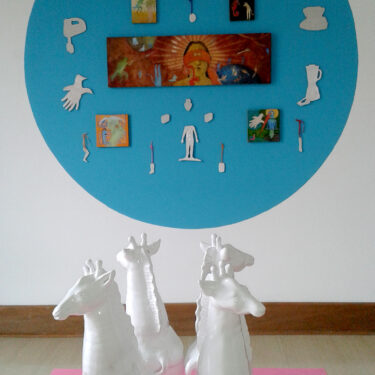
At the same time, in the works we are about to encounter, these mythical beings appear and coexist within a surreal world alongside a series of everyday objects. The grater, the coffee maker, the blender—in short, the domestic world becomes a refuge from the strangeness of the unfamiliar. The landscape changes, as do the people and languages, but everyday objects remain there: stable, quiet, solid. When everything else is volatile and impermanent, the domestic becomes an anchor to reality.
Loading Viewer...
Loading Viewer...